CORE PRACTICE AT LINLITHGOW ACADEMY
What is our educational vision as a school?
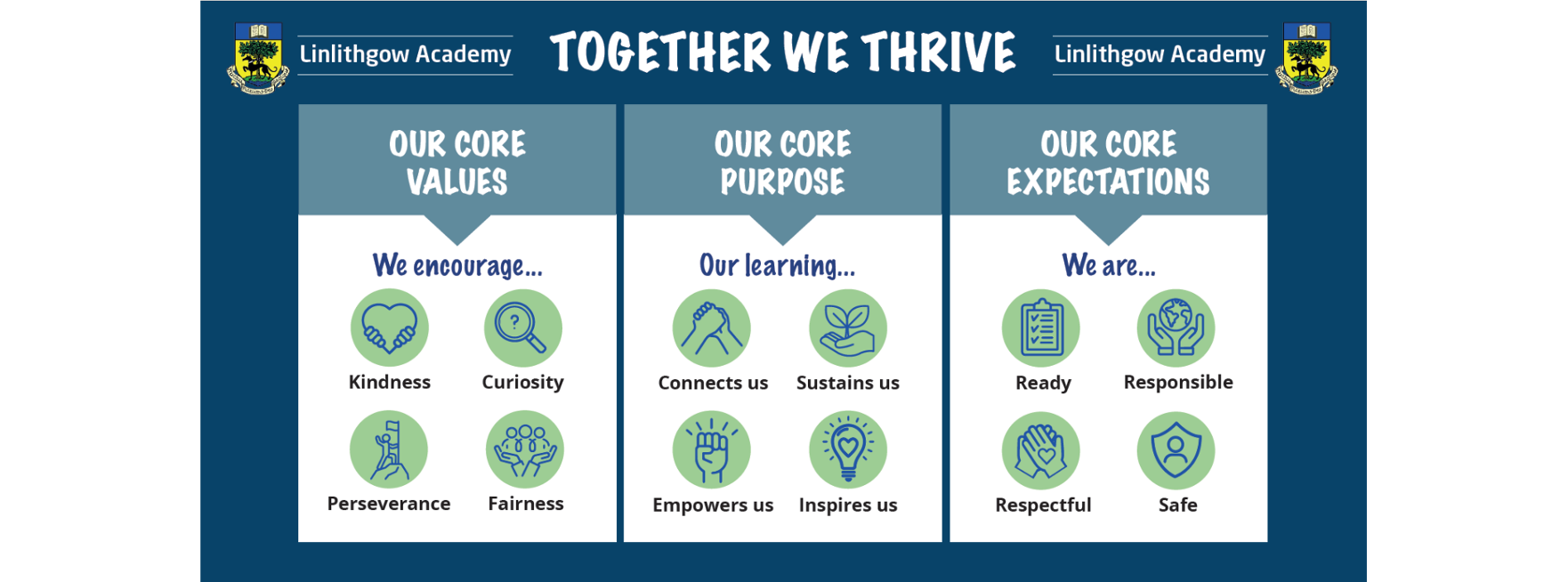
Our core purpose as a school is to promote the flourishing of our students and to enable them to thrive, both now, and throughout their lives. This moral purpose is expressed by our school vision and values and stated explicitly in four principles that form the heart of our vision for learning and teaching:
- Learning connects us
- Learning empowers us
- Learning inspires us
- Learning sustains us
These principles define our core purpose as a school and provide clarity and direction as we continue to improve the quality of education across our school community. As aspirational prompts, they remind us of what matters (and what ought to matter) in our classrooms and inform our culture of learning and teaching at Linlithgow Academy. Our CORE learning and teaching 'framework' elaborates on these principles by providing a shared structure through which to take forward pedagogical improvement in the classroom.
Positive, nurturing and supportive relationships are central to this educational vision. As such, the promotion of positive relationships across our school community is a precondition for our enactment of CORE approaches in the classroom.
What do we mean by 'CORE' practice?
As a school, we recognise that learning is an inherently social, interactive and situated process. Put simply: we learn in and through our relationships with others in environments that are conducive to learning. Although this may appear to be a truism, this statement expresses a double truth. For we learn through educational encounters with others. Not least, through the pedagogical relationship between students and teachers, a relationship that can take many forms, including, but not limited to, direct instructional teaching (perhaps by way of explaining and modelling); and carefully structured cooperative and collaborative learning, classroom discussion and debate, where it is the interactions between students that are paramount. However, it is also through engagement with meaningful educational content that students are brought into connection with others as their perspectives on the world are opened up and enlarged by their learning. Here, dimensions of learning like the capacity for empathy, respect for diversity and difference, the appreciation of nature, and ethical and aesthetic sensibility more generally, connect students with each other, with others more generally and with the world, evoking responses in them that may be at once attitudinal and affective.
CORE
noun
1: the most essential, fundamental, or significant part of something, the 'heart' of anything 2: one's heart's core; the innermost or deepest part of a person
adjective
1: central to the existence or character of someone or something 2: essential, fundamental, key
By ‘core’, therefore, we mean a set of teaching practices through which we enact our vision of the educational good by activating curricular content to promote the flourishing of our students in the broadest sense. We recognise this core to be dynamic and relational, at its heart, since it concerns the relationship between young people, teachers and the content that we select and shape through our curriculum making; the purpose of which is to develop the educational potential of our students, both in terms of knowledge acquired and the formation of character more generally.
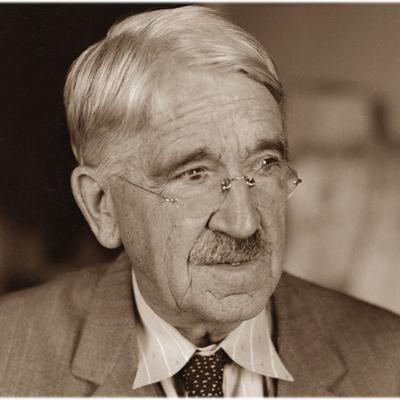
The most important attitude that can be formed is that of desire to go on learning.
John Dewey
What are the elements of 'CORE' practice?
The 12 ‘elements’ that comprise our common core of practice are interconnected and mutually reinforcing. Although these elements are organised by strands (using the letters of the word 'core' as a mnemonic device to support collective practice), they have been arranged in sequential order for the purpose of lesson planning, curriculum making and pedagogical improvement. In this regard, then, they function as animating principles, in the sense of sources of action, and are intended to inform the process of lesson preparation and guide the selection and presentation of content we use to engage students in our classrooms.


When everyone in the classroom, teacher and students, recognises that they are responsible for creating a learning community together, learning is at its most meaningful and useful.
bell hooks
Student engagement is crucially important. The pedagogical approaches we deploy in our classrooms and the tasks we design are intended to excite students’ interest in learning and provide a fillip for student participation in lessons by stimulating curiosity, making students think and provoking classroom dialogue and debate. Indeed, to place students at the heart of our educational endeavours, as national policy enjoins us to do, is at once to acknowledge our students as 'core participants'* in all aspects of their learning and thus to prioritise those approaches that are most conducive to engaging students in this way. It is this pedagogical imperative that animates our practice and that arguably forms the moral heart of CORE.
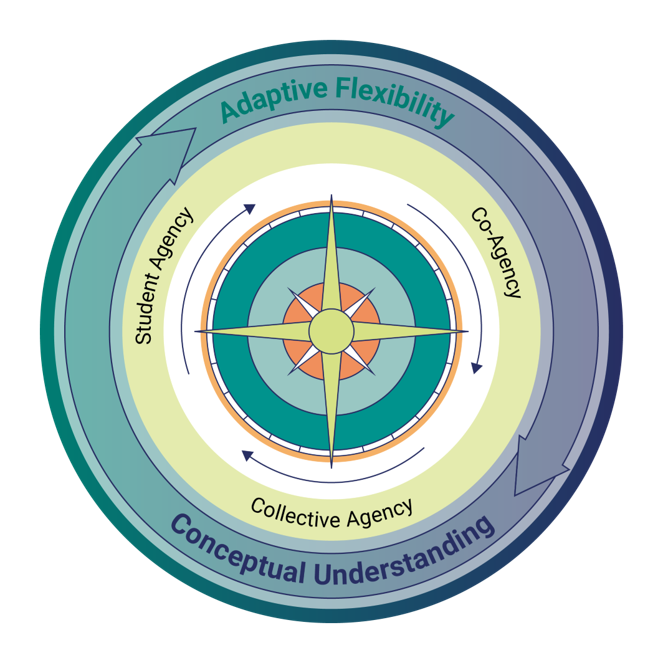
The learning environment recognises learners as core participants, encourages their active engagement and develops in them an understanding of their own activity as learners.
OECD, The Nature of Learning
Our elaboration of the 'pedagogical core' draws inspiration from a wide range of educational literature and research, particularly research focused on improving the quality of teaching and learning by attending to what is referred to variously as the ‘instructional’ or ‘didactic’ core of pedagogical practice, a core that is at once the locus for curriculum making because questions of educational content and task design are fundamental to the preparation of lessons.

You don't change performance without changing the instructional core. What matters is whether you can see it in the core. If you can't, it's not there.
Richard Elmore